Rhythm is pitch.
The starting point
A rhythm and a musical tone can come from the same repeating event. VERTIGO makes that connection visible and playable: a dot reaches a polygon corner, an impulse sounds, and the motor changes the timescale.
What I built
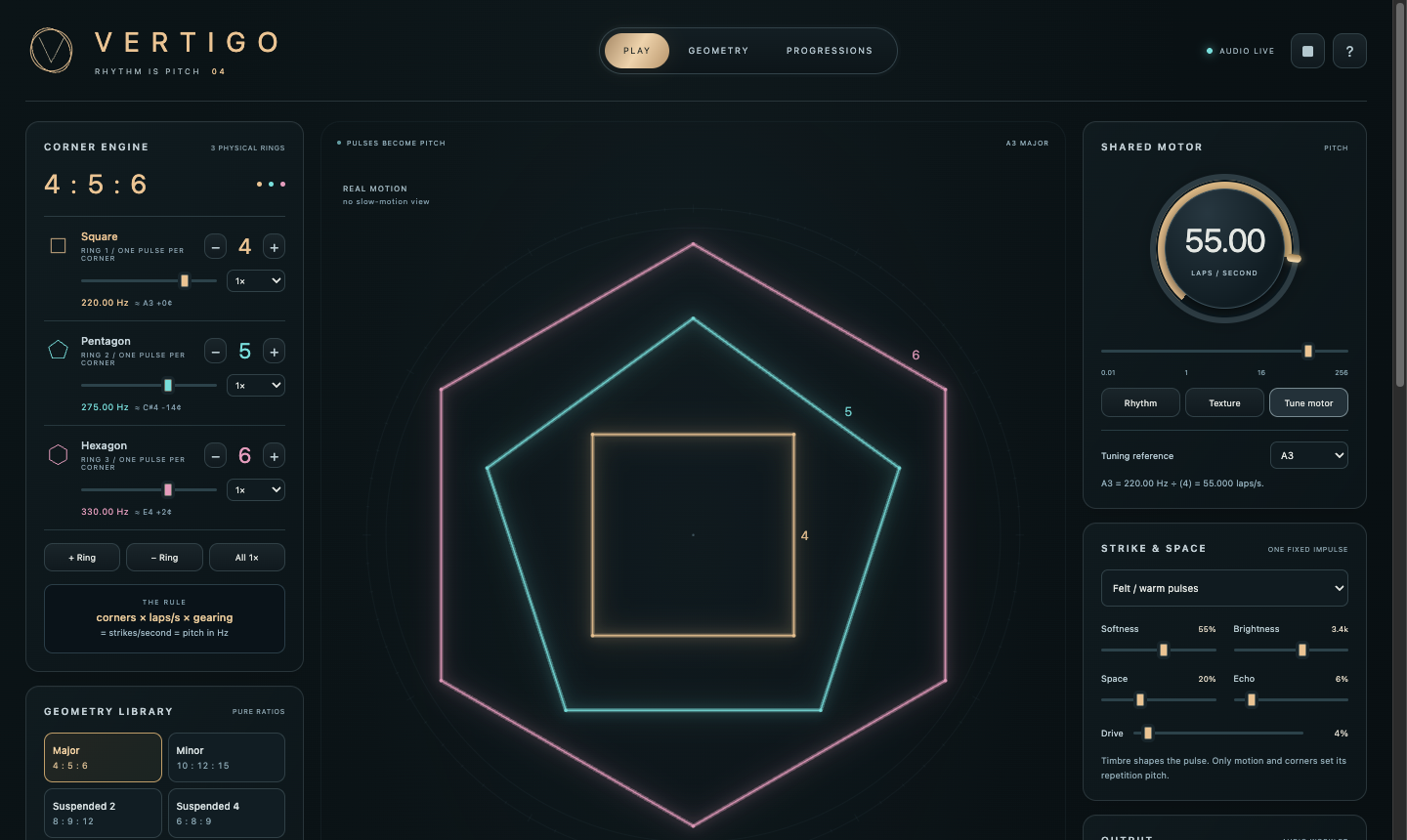
Each ring has a polygon and a moving dot. Crossing a corner creates one impulse. At low speed, the rings form interlocking rhythms; at high speed, those same repeating impulses become tones. The sound follows the geometry throughout the transition.
Corner count, the shared motor speed and each ring’s gearing determine the repetition frequency. Four, five and six corners at 55 laps per second produce 220, 275 and 330 Hz. The geometry library builds major, minor, suspended and extended pure-ratio chords; the tuning reference calculates a motor speed.
Change up to four rings, their gearing and levels, reverse their motion, or take the guided journey from rhythm to pitch. Strike materials, filtering, saturation, reverb and echo shape the sound. Visual afterglow changes the drawing without changing the motor.
A progression stores the actual geometry and motor settings at each step. Choose a starting route, change a chord, or capture the current machine into a sequence of up to eight steps. WAV export renders the current sound, a progression or the rhythm-to-pitch journey; live recording captures the synth output.
Patches can be saved as JSON and loaded again, and the last settings stay in the browser. The instrument runs from one self-contained HTML file, with an AudioWorklet pulse engine and a compatibility path. It uses no external libraries, microphone input or hosted audio service.
The instrument’s help retains its references to earlier explorations of the relationship between pitch and rhythm. Its pure frequency ratios are part of the experiment; they do not follow equal-tempered piano tuning.